Monday, January 16, 2012

W. S. Graham - Listen. Put on Morning


Listen. Put on morning.
Waken into falling light.
A man’s imagining
Suddenly may inherit
The handclapping centuries
Of his one minute on earth.
And hear the virgin juries
Talk with his own breath
To the corner boys of his street.
And hear the Black Maria
Searching the town at night.
And hear the playropes caa
The sister Mary in.
And hear Willie and Davie
Among bracken of Narnain
Sing in a mist heavy
With myrtle and listeners.
And hear the higher town
Weep a petition of fears
At the poorhouse close upon
The public heartbeat.
And hear the children tig
And run with my own feet
Into the netting drag
Of a suiciding principle.
Listen. Put on lightbreak.
Waken into miracle.
The audience lies awake
Under the tenements
Under the sugar docks
Under the printed moments.
The centuries turn their locks
And open under the hill
Their inherited books and doors
All gathered to distil
Like happy berry pickers
One voice to talk to us.
Yes listen. It carries away
The second and the years
Till the heart’s in a jacket of snow
And the head’s in a helmet white
And the song sleeps to be wakened
By the morning ear bright.
Listen. Put on morning.
Waken into falling light.

Rabindranath Tagore - (“Sing the song of the moment...”)


VII

Sing the song of the moment in careless carols, in the transient light of the day;
Sing of the fleeting smiles that vanish and never look back;
Sing of the flowers that bloom and fade without regret.
Weave not in memory’s thread the days that would glide into nights.
To the guests that must go bid God-speed, and wipe away all traces of their steps.
Let the moments end in moments with their cargo of fugitive songs.

With both hands snap the fetters you made with your own heart chords;
Take to your breast with a smile what is easy and simple and near.
Today is the festival of phantoms that know not when they die.
Let your laughter flush in meaningless mirth like twinkles of light on the ripples;
Let your life lightly dance on the verge of Time like a dew on the tip of a leaf.
Strike in the chords of your harp the fitful murmurs of moments.

Tuesday, January 3, 2012

Diane di Prima - Buddhist New Year Song


I saw you in green velvet, wide full sleeves
seated in front of a fireplace, our house
made somehow more gracious, and you said
“There are stars in your hair”— it was truth I
brought down with me
...

The author's web site

Monday, January 2, 2012

Renee Vivien - Your Strange Hair


I burn the whiteness of your fingers with kisses.
The night air spreads the dust from many worlds.
Still I don't know anymore, in the heart of those deep nights,
How to see you with the passion of yesterday.

Sunday, December 25, 2011

Thursday, December 22, 2011

Winter Solstice


In the northern latitudes, midwinter's day has been an important time for celebration throughout the ages. On this shortest day of the year, the sun is at its lowest and weakest, a pivot point from which the light will grow stronger and brighter. This is the turning point of the year. The romans called it Dies Natalis Invicti Solis, the Birthday of the Unconquered Sun.

The Roman midwinter holiday, Saturnalia, was both a gigantic fair and a festival of the home. Riotous merry-making took place, and the halls of houses were decked with boughs of laurel and evergreen trees. Lamps were kept burning to ward off the spirits of darkness. Schools were closed, the army rested, and no criminals were executed. Friends visited one another, bringing good-luck gifts of fruit, cakes, candles, dolls, jewellery, and incense. Temples were decorated with evergreens symbolizing life's continuity, and processions of people with masked or blackened faces and fantastic hats danced through the streets.

The custom of mummers visiting their neighbours in costume, which is still alive in Newfoundland, is descended from these masked processions.

Roman masters feasted with slaves, who were given the freedom to do and say what they liked (the medieval custom of all the inhabitants of the manor, including servants and lords alike, sitting down together for a great Christmas feast, came from this tradition). A Mock King was appointed to take charge of the revels (the Lord of Misrule of medieval Christmas festivities had his origin here).

In pagan Scandinavia the winter festival was the yule (or juul). Great yule logs were burned, and people drank mead around the bonfires listening to minstrel-poets singing ancient legends. It was believed that the yule log had the magical effect of helping the sun to shine more brightly.

Mistletoe, which was sacred because it mysteriously grew on the most sacred tree, the oak, was ceremoniously cut and a spray given to each family, to be hung in the doorways as good luck. The celtic Druids also regarded mistletoe as sacred. Druid priests cut it from the tree on which it grew with a golden sickle and handed it to the people, calling it All-Heal. To hang it over a doorway or in a room was to offer goodwill to visitors. Kissing under the mistletoe was a pledge of friendship.

Above from Winter Solstice Traditions
Link to photo sourceLink

Tuesday, December 20, 2011

Muriel Rukeyser: Night Feeding


Deeper than sleep but not so deep as death
I lay there dreaming and my magic head
remembered and forgot. On first cry I
remembered and forgot and did believe.
I knew love and I knew evil:
woke to the burning song and the tree burning blind,
despair of our days and the calm milk-giver who
knows sleep, knows growth, the sex of fire and grass,
renewal of all waters and the time of the stars
and the black snake with gold bones.

Black sleeps, gold burns; on second cry I woke
fully and gave to feed and fed on feeding.
Gold seed, green pain, my wizards in the earth
walked through the house, black in the morning dark.
Shadows grew in my veins, my bright belief,
my head of dreams deeper than night and sleep.
Voices of all black animals crying to drink,
cries of all birth arise, simple as we,
found in the leaves, in clouds and dark, in dream,
deep as this hour, ready again to sleep.

Monday, December 5, 2011

The Great Sea


“THE GREAT SEA ...”

By Uvavnuk

The great sea

frees me, moves me,

as a strong river carries a weed.

Earth and her strong winds

move me, take me away,

and my soul is swept up in joy.

—Translated by Jane Hirshfield

Uvavnuk, untitled shaman song, translated by Jane Hirshfield, from Women in Praise of the Sacred

Friday, December 2, 2011

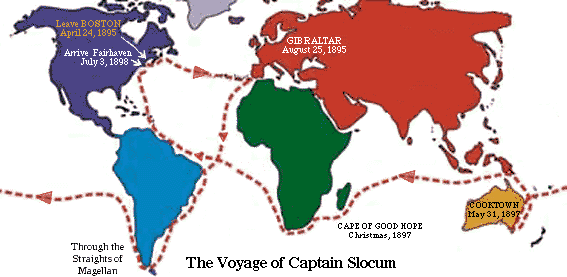
Joshua Slocum

"I was born in the breezes, and I had studied the sea as perhaps few men have studied it, neglecting all else."